
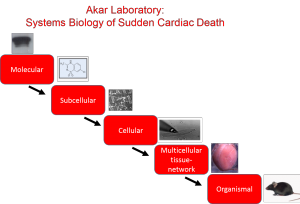
The mission of the Akar Cardiac Bioelectricity Research laboratory at ISMMS is to uncover the mechanisms underlying sudden cardiac death across a variety of clinically relevant structural heart diseases. We use integrative tools that allow us to undertake a systems biology approach to the investigation of arrhythmia mechanisms and to test novel treatment strategies. A major focus of our work is the investigation of abnormalities in impulse formation, conduction, and repolarization in heart failure, and the elucidation of underlying cellular and molecular mechanisms, using state-of-the-art electrophysiological, biochemical, and molecular techniques. Specific areas of active research include mechanisms of mechano-electrical feedback, the electrophysiology of mechanical dyssynchrony and resynchronization therapy in canine and porcine models of heart failure, the interaction of myocardial energetics and electrical function in post-ischemic remodeling and reperfusion related arrhythmias, and the role of altered gene expression and targeted gene delivery on ion channel function and arrhythmogenesis in cardiovascular diseases. Read more.