The CRIPT network and research structures span all continents, allowing worldwide sampling and isolation of human and animal influenza viruses. CRIPT is ready to implement a pre-pandemic and pandemic emergency response in the case of the start of a new influenza virus outbreak, by providing the expertise and the tools required for the collection, analysis and genotypic and phenotypic characterization of viruses in primary human cells/tissues and multiple animal models of pathogenesis and transmission (including those requiring high levels of biocontainment); collection of samples from infected individuals to understand host responses, pathogenesis, transmission and immunogenicity in humans; generation and distribution of reagents; and testing of antivirals and vaccines against the emerging viruses.
See the overall CRIPT Scheme.
Center for Research on Influenza Pathogenesis and Transmission (CRIPT)
Research
CRIPT conducts several human longitudinal studies aimed to better understand the factors that impact the response to influenza virus vaccination, the severity of influenza virus infection, the human-to-human transmission of influenza viruses as well as the genotypes and phenotypes of influenza viruses causing disease in humans.
The following cohorts are part of CRIPT:
- Responses to vaccination cohorts
- Severity of infection cohorts
- Human transmission cohort
- Surveillance in hospital settings cohort
Under the CRIPT we have assembled four Research Projects that represent a continuation of the previous CRIP five projects and a cohesive effort to bring our understanding of influenza virus biology to the next level. We expect these Research Projects will lead to novel discoveries of importance for the rational development of influenza virus vaccines and antivirals, and that will continue training a new generation of outstanding infectious disease virus researchers.
Part A: Zoonotic Influenza Surveillance and Risk Assessment Research
Project 1. Surveillance in animals for potential zoonotic virus strains (poultry/wild birds, swine, and marine mammals)
- Marine Mammals as a transmission bridge from wild birds to humans
- Swine influenza surveillance activities in Chile to understand the human-animal interface.
- Genetic evolution and biological characterization of influenza A virus in canine and swine in China as a transmission bridge from wild birds to humans
- Surveillance of influenza A viruses in domestic and wild populations of Sus scrofa in Spain
- Avian influenza virus surveillance activities in Vietnam and Indonesia
Part B: Acute Human Influenza Surveillance & Risk Assessment Research
Project 2. Influenza Disease Severity: A Comprehensive Analytical Approach in the Northern and Southern Hemispheres
Project 3. Human-to-Human Transmission Studies
Project 4. Genotypic and Phenotypic Characterization of Disease-Causing Influenza Viruses Representative of Global Viral Diversity
In the case of a pre-pandemic outbreak or a pandemic emergency caused by a respiratory virus, CRIPT plans to respond by conducting needed research and surveillance based on CRIPT unique expertise and resources. Our surveillance, clinical, epidemiological, genotypic, phylogenetic, bioinformatics and phenotypic tools will be re-directed upon rapid consultations with NIAID, the CEIRR network, and relevant authorities to answer questions of relevance for a public and animal health response.
An iterative process will start immediately with daily/weekly conference calls among the different CRIPT associated laboratories and in consultation with the mentioned third parties in order to divide the work among CEIRR centers needed for rapid assessment of the characteristics of the pandemic viruses, as it was done during the 2009 pandemic, and more recently during the pandemic with SARS-CoV-2.
Under the new CRIP (CRIPT) we have now assembled four new Research Projects that represent a continuation of the previous five projects and a cohesive effort to bring our understanding of influenza virus biology to the next level. We expect these Research Projects will lead to novel discoveries of importance for the rational development of influenza virus vaccines and antivirals, and that will continue training a new generation of outstanding infectious disease virus researchers.
Part A: Viral Emergence, Evolution and Transmission
- Research Project 1. Virus Determinants of Tropism
- Research Project 2. Antigenic Evolution and Transmission
Part B: Immune Response to Vaccination and Infection
- Research Project 3. Antibody Responses to Vaccination and Infection
Part C: Influenza Disease Severity
- Research Project 4. Host Determinants of Virulence
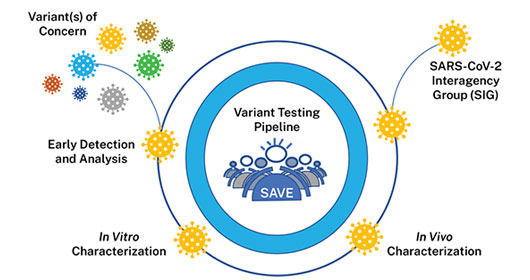
The global emergence of many severe acute respiratory syndrome coronavirus 2 (SARS-CoV-2) variants jeopardizes the protective antiviral immunity induced after infection or vaccination. To address the public health threat caused by the increasing SARS-CoV-2 genomic diversity, the National Institute of Allergy and Infectious Diseases within the National Institutes of Health established the SAVE program. This effort was designed to provide a real-time risk assessment of SARS-CoV-2 variants that could potentially affect the transmission, virulence, and resistance to infection- and vaccine-induced immunity. The SAVE program is a critical data-generating component of the US Government SARS-CoV-2 Interagency Group (SIG) to assess implications of SARS-CoV-2 variants on diagnostics, vaccines, and therapeutics, and for communicating public health risk.
More information on the SAVE program can be found in NIH SAVE Program Website